Saturday, December 12, 2020

Myths of the World: The Shadowkind

The origins of Feyland have long been an object of contention between historians, as they mostly bypass the role played by their Undergroundian counterparts. Traditionally known as the Shadow Elves, Hidden Elves or Underelves, the peoples of the Shadowkind are very little seen on the Surface, and even then only around the gilded outskirts of Feyland. 

Chiefly among the Feyland lorekeepers, the Shadow Elves are equally heeded as long lost siblings, elder foes and forgotten visitors, though their account of the meaning behind such epithets remain mostly anecdotal. What they generally see to agree upon is that, for some reason, their ways drifted apart. Somewhere far back in time, the Shadow Elves just vanished from all accounts in the matters of the Surface, just to reappear again only hundreds of years later, this time in diplomatic documents listing the concession of ambassadorships to certain figures of Shadow Elvish origins.

Perhaps it is from that time that we have the most updated description of their culture and ways. In one particular register, the scribe mentioned the incredible city of Umaúl, home to the Shadow Elves and forever hidden from foreign eyes by means yet to be understood. It then refers to some sort of structure that lies in the very center of their country, sprawling from somewhere on the top and extending its tendrils everywhere around it, surrounding buildings, rivers and trees.

As for the Shadow Elves per se, it is told that they are much like their Surface brothers in kind, though their hair has gone completely white and their skin is almost exclusively dark grey or pitch black. The leaves that spring from their hair are those of the Fall and Wintertime, and their eyes glisten with crystal white amber. 

As per some records, Shadow Elves are unseemingly heavy, and no reason has ever been provided to explain that fact. Their footsteps dig deep into the dirt and, when they fall, others usually leave them where they lay, as they cannot bear to carry them along. Some speculate it must be something in their bloodsap, a dark, thick liquid that bleeds very slowly whenever it is brought forward by a wound or otherwise; a few others theorize that it must be something in their bones, with some claims that it is in fact made of an extremely hardy material, similar to ironwood in some ways. One way or the other, it is hard to notice that from their slender figures alone. To know if one belongs to the Shadowkind, one must only look over their footsteps and see how deep they go.

Regardless of what has happened in the past, the sense of rivalry between Surface Elves and Undergroundian Elves remains. Even if any hostility has faded over the millennia, and the very reason for it fairly forgotten, Elven bloodlines run deep and remember, even when the receptacles of their vital streams do not. All that is left for them is to live as an afterthought of something far, far grander than themselves. 

Of course, Elven peoples, regardless of their heritage, will hardly ever accept that feeling out loud.

Wednesday, August 5, 2020

Gods of the World: The Triad

The Triad, otherwise known as the Larmes or the Reapers, are deities that reign over the birth and death of all things, from their inception to their eventful demise as they fulfill the cycle of their lives. They are often worshipped in rural communities, so that they may bless their crops, the wellness of newborns and a comfortable departure for those who have not much longer to live. 

In most regions, the Triad are represented by three female figures intertwined, sometimes holding hands, as if dancing, sometimes with their backs to each other. In some remote territories, the Triad are known for being depicted by three male figures displaying heavy bellies and plump faces, though more often than not it is possible to find busts and medallions where they wear a piece of cloth over their eyes.

Tuesday, August 4, 2020

Myths of the World: Craucoa

An immense being, sometimes mistook for an island in the sea or a mountain on the land, waiting and dreaming their unfathomable dreams until they wake up. Craucoa's awakenings are said to happen once every five hundred years or so, usually related to tales of earthquakes, tidal waves and volcanic eruptions. Despite certain legends, the destruction that follows the rise of Craucoa has nothing to do with their ill temper or inherent evil; according to at least one account from a small girl that lived a long time ago, Craucoas are never angry, only very much dissatisfied with the reality outside of their deep slumber. Once the earth shattering events subside, it is said that they become much smaller, fitting perhaps inside one's closed fist. How come do they happen to grow to such colossal sizes remains to be seen.

Thursday, July 23, 2020

The Nature of Magic

Dear Cybiline,

It is with a cautious heart that I receive news that you wish to take an apprenticeship at a weavery. As your second-mother, I probably have a say or two on the matter, though I'm not sure you'll like it.

I know I have countless times turned to these miserable pile of papers to spill my frustrations and distill from them meaning, or at least the shadow of a sense that could be rescued amid the endless stream of nonsense that washes over us all, weavers. The feeling is not new, at least not for us, elders in the craft. Still, the frustration never gets old, does it, really?

Magic it seems to you, but how close to the mundane it is. It baffles even me at times. It doesn't matter that we say that it's not a deep mystery and that anyone can do it, but they're always looking for cryptic shortcuts, for intricate games of the mind. How many charlatans have profited from it! How many rose to power because of it!

But this... This power that comes from all matter is so disappointingly simple to understand. 

The problem, of course, is, first, how to set your intuitions to the right spectrum. And the second, to hone that intuition.

Now, that's where things get tricky. Weavers of all walks of life have dedicated themselves to do just that, being them learned or naturals. How many books have been written to describe the most precise of methods just to help people get a grasp of the ficklest sensibility to that notion? I have piles of them and could burn half, for all I care. If you want to be a weaver, you have to expose yourself to weaving. Breath it like you breath the very air that enters your lungs, my dear. That's key, though I'm afraid it's not the only one.

With time, you'll see how your intuitions will bear fruits, so many fruits. It's like something clicks in your mind, really. You'll know when it happens, and when you do, everything else will follow. You'll be able to interpret without effort, and know where such and such bits go together.

Well, it's true that many people use words or trinkets as clutches to interpret the Texture. Don't feel embarrassed if you come to need them, only pigheaded weavers make a big deal out of it. Me included, but that you already knew.

But I said to earn and to hone your intuitions were a problem. Yes, they are, only inasmuch as they do not come with structured education or practice, but with experience from exposure. And that changes wildly from place to place, and even from person to person. If you endure that process, then there's nothing to worry about: you'll be a weaver in no time.

The true problem, and I can't emphasize it enough, is to lose yourself in the weaving.

Now, heed my words, and promise me you will not forget them. This is the only thing that you must not let go, lest all goes to ruin and another good weaver is lost to it.

Do. Not. Interpret. Beyond. Reach. That is the golden rule, the definitive ban, the unavoidable warning. Every time you do it, you go further down the untamable underbelly of the Texture. Every time you come back, you bring a little bit of the untamed with you.

Weavers who go deep into the Untamed start interpreting everything wrong. And that's where the ruin begins.

But enough with gloomy discussions. I know you will make the best decision and be a baker instead.

Just kidding. But if you choose to be a weaver, go and be a competent weaver. And more importantly, a sensible one.

Now, I've emphashized more words than I care to in a single letter, and you're not even one of my apprentices. Go and be a kid, you'll be fine.

And send me a package of sweet tapiocas with your next letter, or else I won't dignify to respond.


Sincerely yours,

Your most devout (and mostly tired), 

Giedana Armestrome, Head Interpreter of the Heiendam

Wednesday, July 22, 2020

The Fate of the Dwarves

Esteemed Duval,


I received your letters with the greatest anticipation. I am glad you start to make the right questions, instead of the simply convenient ones. It caught my attention, however, that you have missed a great deal about the recent history of the Dwarves, so I took upon myself to illuminate you, however briefly, on some pieces of information that might kickstart your own research on their apparent exile.

It has long been speculated about the woes of the Dwarvish peoples, masters of the moors and highlands of the Northeastern Territories. For some, they seem to have dwindled into extinction, but to others, it has been all but a ruse to reinstate the High Thorn as the epicenter of Dwarvish communities.

Erratic reports have lent little but weak evidence either way: the peoples of Baladrogue are known to have moved up North, across the Scorching Rings in the search of suitable, untamed lands to settle in. Cnoctans moved further East, beyond the frontiers of the Gorge, from where it is said that they built great ships to sail across the Sea of Salt. What engineer did they have to build such marvelous machines one cannot know, though they have probably perished in those ravenous waters.

Recently, however, it has come to the knowledge of experts that the peoples of Clanclade and Raiquers have taken another road, one the goes below the Surface. Though the hate of the Dwarves for the Underground is widely known, it seems the Cans and Quers, as the jargon among anthropologists go, were desperate to leave the Surface. What motivated them to take such a radical route is still a mystery to many, though some explanations have been offered in the past few years.

The best accepted theory hypothesizes that a prestigious seerperson from among the Cans and Quers made a catastrophic prediction. Generally, such predictions are not so strong as to drive the Dwarves to take such radical measures, but the peculiar circumstances of such prophecy are still very much unfathomable.

One other theory, and a more controversial one, proposes that the three peoples have actually formed a great alliance, none of which has been seen ever since the days of the Great Descent. According to this one notion, the Dwarves have decided to populate the unchartered worlds, leaving all of the Continent behind.

It is certain, however, that such a theory needs much improvement in certain aspects. For example, all these people as a whole have a history of absolute obsession regarding their land and their territories. Would they give them up so easily in p     ursuit of mysterious threads in the dark? I don't think so.

Another sore point would most certainly refer to this uneasy - at best - alliance among these people. Do you think they would just flock together and put together such extravagant machinations? Well, that is what I would very much like to ask Ms. Erdebrando (in fact I did a few days ago).

Thus I break myself from this letter. Remember to work on sections 23 and 24 of your thesis, they are simply dire. And you know I say this only because I know for a fact you can do better.


Sincerely yours,


A. Selva, Geographer to the Dims
17 of 10, Year 766 of the Horn Calendar

Saturday, July 18, 2020

The Great Descent

The Great Descent, or the Great Expulsion, tells the story of the long exile of the Tieflings in the Underground. Once proud, majestic rulers on the Surface, the Tieflings became too greedy, too eager, quickly sprawling over frontiers that should not be crossed and finding resistance from those that inhabited therein. Driven by inner turmoil, the diseases that took hold of Tiefenland started to infect the Surface as a whole.

A universal front to halt the advancement of the Tieflings was formed, and thus the horned peoples were pushed back to their land, and beyond. The fear in the hearts of some, who thought Tiefenland would rise again, sooner or later, led to a series of treaties, threats and deals that eventually sent all of their great houses into the darkness of the underworld. A tacit ban on the presence of large Tiefling communities on the Surface took hold along the years, until very few prospered and kept roots on their motherland.

The Tieflings, however, did not take long to get along with their new habitat and flourish. A home is a home, even where the sky is not there to welcome you. And thus the Terratarium was founded and still prospers to this day.

Friday, July 17, 2020

Places of the World: Tarimbo

Tarimbo, otherwise known as the Rounded Jewels of the Western Bank, is a citadel located upon the Resilient Coast in the Underground. Its many towers rise in the shape of wide mushrooms made of rock and stone, bursting with peoples from all walks of life: Gnomes from Dartarilho, Grey Dwarves from Tawapã and Deep Gnomes from Elterobim, all peoples of the Resilient Alliance. Needless to say, the Alliance was formed from the political effort between several territories to the East of the Endful Sea.

Some bigger folk, such as Tieflings, from Tiefenland, and Lizardfolk, from elsewhere, also make a living behind its walls, most of them artisans, merchants and sell-swords. Upon close inspection, one could also find a few Black Orcs from the Banners, but any other peoples besides them are much more difficult to find.

The citadel is a feast of sensations: open markets, narrow streets, festive flags and lights overhanging alleys. Most buildings are tall enough for the taller species to enter, but still comfortable for the taste of shorter patrons. A visitor could walk for hundreds of days among the streets of Tarimbo and still miss most of its features, such as the constellation of shrines dedicated to the many demigods worshipped by the peoples of the Alliance.  

Tarimbo is ruled by a council formed by respectable families of Gnomic, Grey-Dwarvish and Deep origin. They seldom meet, only doing so when the matter is of the gravest importance. Their last summit happened not too long ago, upon the arrival of the White Eternal on the Surface.

Tuesday, May 5, 2020

Gods of the World: The Lightless

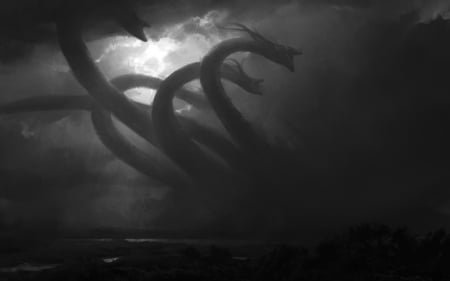
The Lightless are the wardens of secrets, shadows and symbols. They preside over everything that must be hidden, withheld or disclosed for a greater purpose. As a polymorphic deity, the Lightless are generally represented as an amorphous figure with long necks and multiple heads, sometimes hidden behind enigmatic masks. They are said to have had multiple mortal incarnations throughout history, with the original form dating back from the Great Birth in the beginning of time and space.

The deity is surely ambiguous and ambivalent in its domains and purposes, which leads to a variety of followers from sometimes entirely opposing factions. This may implicate, for example, in the emergence of conflicts between those that wish the safekeeping of a certain piece of object or information whose disclosure might be too dangerous, and those that wish to destroy it for the same reason.

The Lightless are also connected with the transience of life, the withering of memory and the ultimate passing of all things, with its theologists pointing that everything that is tends inevitably towards the Great Void, in opposition to the Great Birth that once originated them. Their priests are usually hired to undertake the sending of the dead in some cultures.

Symbols, signs and language are also believed to fall under the protection of the deity by many, as a means of both encrypting and decrypting meaning from conscious and unconscious communicative efforts from all beings. It is said that the Lightless have the power to lay down the shadows of the unknown but also to pull them away, in the pursuit of the veiled truths about existence.

The Numbers of Caribdis are some of the organized groups that are known to worship the Lightless. The Winged Darkness, an extremist sect connected to the Numbers, believe that the deity is not a many-headed entity, but a single-headed one. They seek to destroy any source or material that spreads lies and deceit about an apparent polytheistic nature of the god, as opposed to a god of many incarnations, as they themselves believe.

Source here.

Gods of the World: Tellabac

Tellabac, the Unstoppable Herald, is the warden of roads, merchants, travelers, trade, thievery and cunning, both on the Surface and in the Underground. She is generally depicted as a beast, half-humanoid female, half-horse, and is said to never have halted her stride ever since she achieved godhood. Tellabac favors wisdom and wit above all else: one of the main proverbs attributed to her is “Where there’s a will, there’s a way”.

According to folklore, Tellabac can sometimes be seen riding fast on different roads in the height of fateful events like wars or plagues, from whence derived the notion that ill news tend to travel faster than any other.

It is not known when thieves and other roguish types began worshipping Tellabac; some say she was once one of them, a master of lock and keys that could open any door or any chest. A very known tale in Malimar is that in which Tellabac convinces a chest to unlock itself and reveal its contents, from which perhaps the rumors became more widespread.

In general, she is regarded as a herald of news, good or ill, an opener of ways and a bringer of opportunities. She is also favored in all matters of treasure, trade or trickery, upon the belief that everything must flow and nothing should remain locked, trapped or hidden for long.


Image sources (from left to right): Figure 1, Figure 2, Figure 3, Figure 4.

Friday, April 3, 2020

Places of the World: The Terratarium

Tiefenland is in fact the name of all the land over which the Chamber of Horns holds any authority, but its heart belongs to one place and one place alone: the Terratarium.

Ever since the Great Expulsion, when the Tieflings were turned by the Surface dwellers and banned to the Underground, Tiefenkind have resided in the bowels of the earth and reconstructed its mighty civilization from a rocky scratch. After a few hundred years, they built an architectural work to put to shame any of those they had built before, a wonder colored by a thousand shades of cobalt and illuminated by roaring rivers of lava that spring from the ground. Its name is Terratarium, and one of the greatest places below the Surface.

That was only possible due to the renowned Tiefling bureaucracy and industriousness. Being pragmatic beings at heart, Tieflings organize their lives around very structured systems in everything they do. For that reason, their collection of laws is one of the most extensive among sentient cultures.

With time and expansion, Terratarium also lends its name to its surroundings and beyond, effectively serving as an umbrella term to most of the Tiefling urbanities that developed around it. The web of roads that link all of these urbanities is one of the most complex transportation systems, both under and over the Continent.

The lands of the Terratarium possess soils so rich, black and humid that Tieflings can cultivate them in constant cycles, regardless of the season (even if the Underground has only two of them). It is for that reason that its vineyards are well regarded for their excellent produce. Tieflings have developed an extensive system for carrying out the crops that uses skilled corps of druids to tend over the land and to propitiate state of the art food production all around Tiefenland.

All these technologies, however, are put to use in the service of one single purpose: expansion.

This was the main reason why the Tieflings were expelled to the Underground during the Great Expulsion, as their imperialistic ambitions have no means to subsist unless all else is conquered, either by militaristic, economic or cultural means. They live to explore, to enlarge and to push the borders of Tiefenland, and in the process they tend to swallow communities and civilizations whole.

The Next Frontier is both a sentiment of the population and a policy of state among Tieflings. It refers to new lands, new peoples and new beginnings to be integrated to the hungry Terratarium machine. There is always a next frontier, no matter how far has the Tiefling banners have been set.

Tieflings of the Terratarium are, in general, politicized, pragmatic, bureaucratic and tolerant. As they take over or bring in a diversity of communities through their never-ending expansion, they usually receive well these new populations, regardless of their race or origin. This certainly contributes to the strategic renewal of Terratarium longevity.

Almost all of the Tieflings deny or mock any particular reverence to gods, at least in the terms of organized religions and usual believers. Their pragmatic minds have difficulty in grasping the whole need to worship extremely powerful beings just for the sake of their overinflated egos. In their perspective, if such beings need to be pampered and tended to their every whim, perhaps they are not very worthy of any worship at all.

There are only two mundane things that might stop the Terratarium on its tracks: the rebuke of civilizations more powerful than their own (which led to the Great Expulsion), and the constant dispute among their divided elites. If you cannot conquer them by force, then the best way out would be to conquer them using their own political devices.

At the moment, the Terratarium has been rather occupied with incursions from their ancestral foes, the Black Orc nations, and with the constant arrival of refugees from the Surface, in the aftermath of the climactic apocalypse started by the White Eternal. This influx of immigrants has led to continuing  difficulties in the maintenance of their food supplies and overpopulation in some urbanities, as well as to the slowing of Tiefenland expansion in some fronts. A few dissonant senators within the Chamber of Horns have been leading a virulent campaign against the current majority, and everyday they gain more followers in the wake of their public speeches. Among other events, the Terratarium might be heading towards very significant turning points in its near future.

Saturday, March 28, 2020

Places of the World: The Reveries

Millenia beyond reckoning have the Reveries been hovering over the continent, standing afloat in the sky as the closest thing to the stars ever known to the people of Terra.

Terrestrians, as the people of the Reveries call most outsiders, usually refer to them in turn as High Elves, in part for their shared ancestry with the Feyland Elves, in part for the fact that they inhabit, of course, places very high in the sky.

High Elves usually do not care for such arguments, however amusing; their eyes are always and at all times pointed outward. Skyborn, they call themselves, and some never even set foot on the ground below in a lifetime.

Elvenkind from Feyland say that their distant kindred rose to the clouds a long time ago, as dissidents of their own kind. Skyborn, however, beg to differ: in their own history, they never ascended, but, in fact, descended from a higher existence. 

They put their origin at the stars. There, somewhere beyond what is known to the sentient races of Terra.

Unfortunate, for them, who are so judicious and keen-eyed, there is no proof or evidence, except the old stories. Aware of their traditional sense of self-importance, Skyborn spend their lives looking for clues of their heritage, or, at least, musing about it, through their long woven, tightly narrated stories told and sung and played. Skyborn are generally known for how long they take to tell any event to another, and of how they speak with great subtleties.

Perhaps that explains why Skyborn are also generally distant, aloof, or even conceited. Their minds are bred to focus up high, and not down below. When pulled to the everyday struggle of Terrestrians, they simply try to get over with it and to return to the Reveries.

The Reveries are not a single place, but many; the gathering of fortresses in the sky built in times immemorial, connected by many bridges that connect and disconnect as its individual fortifications come and go whenever needed. It is also home to one of the most unique depositories around the continent: the Cloud.

The Cloud is a complex structure of stone and glass, used by the Skyborn to practice their arts of cloud-reading and through which they try to gaze into the history of time and space following the patterns in the clouds. What some put aside as baseless claims, glorified truth-saying and an insidious variety of pseudo-divination, others see it as a sophisticated technique of scrying that actually elevates divination to a level of unmatched precision. As a matter of fact, the Cloud manifests itself in such a way that it allows even the least gifted of the practitioners to read its patterns, effectively functioning as a library of sorts that convey all kinds of knowledge and information. In general, it is easier to read present events, with more difficult patterns being left to the past and the future, which deepens as far you venture into either of them.

Traditionally, the Reveries are ruled by their most skilled Cloudreaders, who are thought to access events with most precision and who are smart enough to know when and how to make the best choices for the Skyborn.

As with other communities, Skyborn are not all intent on figuring out the mysteries of the universe. Many pursue other goals, specially with the Dragonborn, on their high towers, the Birdfolk, in their wandering fleet, and Terrestrians in general. People from the Reveries have sympathy for their distant cousins from Feyland, but the dwindling numbers of the latter have led to less and less contact over the past few centuries.

The Reveries are not being affected by the White Eternal, and for that reason Skyborn are not quite concerned with the ramifications of the perennial winter over the continent.

Biographies, Pt. 3: Rae Maodar

"I'm not sure you're following me."
Rae Maodar, from the Reveries

Most of Maodar's life has been dedicated to the tomes of various shapes and origins, through which he quietly channels his unquenchable need for information of all sorts. The grounds of knowledge of the Reveries are like no others, and many Skyborn like himself are prone to losing themselves - and, more often than not, their minds - in the study of all things past, present and future, half-hidden and half-suggested by the Clouds.

In one of his intellectual wanderings, however, Maodar came in touch with a mysterious, shrouded entity that invited him over his realm and showed him everything he had yet to learn. Of course, only if he allowed himself to surrender to the immense promise of power that laid on the other side.

Disturbed and disquieted, Maodar sought the advice of his elders but to no avail: Elves from the Reveries were never the kind to reply to any question directly, but only through hints and mildly suggested intonations that implied rather than explained.

Usually skilled in such exchanges, as a born and bred citizen of the Reveries, he found it exasperating not to have a clear solution to his dilemma. And when he found himself again somewhere beyond the astral realms, his answer came as quickly as it came unexpectedly: "Yes, lead me through."

Ubbub, the Outlander, grew inside him in a fraction of his galactic presence and bestowed upon him a force and energy he had never felt before. Over the spam of a few weeks he became taller, bulkier,  with figments of arcane energy obeying his every thought and whim; and still, there was room for improvement, for greatness.

For knowledge.

The gift, as usual, had not been given freely.

"There is something I need", echoed Ubbub, swimming among his thoughts.

Maodar's mind was sharp, crystalline, like never before. He never hesitated.

"You need only say what."

Biographies, Pt. 3: Nikelas Ilanthiel

"Wrong things tend to grow when the garden is tended by the wrong hands."
Itamor, head of the Children of the Tree

Ever since Nikelas was found by Boris and the others in the ruins of the ancient coliseum she felt a growing restlesness pulling her thoughts back to somewhere far beyond her mind. The concern of her occult patron became sharper with alarm and anxiety, and she knew she was both coming closer to her (their) objectives and to a will as powerful as Qellerion's own, and as deeply concerned with the fate of the artifact she now had in possession.

Or, that they now had in possession. For, as unfortunate as it was, her party had also come across another Elf, a cousin of her own people among those who left Feyland millennia ago, and that now resided in the highest abodes among all peoples, far beyond the tallest mountains. She saw Maodar at first with suspicion, and little by little she wrapped her head around what he was and what he was doing. Now, she was sure he suffered from the same demands she was burdened with, but the entity he answered to was not at all clear.

Now, after experiencing an extract of the petty wars waged by less clever folks, she pursued her goal with doubled eagerness. The unleashing of her swift eldritch explosions had become as easy as breathing in the course of each battle, and she knew her potential was unlimited.

He reassured her so every step of the way. With amusement, she recalled the look in the eyes of the half-orc when she came over her in the heat of the skirmish with the Black Orcs and invoked the pure essence of the Fey itself to strike her foe in her vile, undeserving heart. Victory is all the taste she has need for, and she wants more.

She knows she has to be careful from now on. Very careful. Whatever her patron is looking for, it is close and, when the time comes, a very difficult decision will have to be made.

But Nikelas, she is not afraid of the cost.

Friday, March 20, 2020

Places of the World: Caribdis

Caribdis is the jewel of the Far West, a ravishing urbanity built upon the cobaltic remnants of a city that existed long ago. Once occupied by the Crimson Brethren after their mythic crossing of the Long Wastes, the settlement grew and now attracts caravans from all places Western of the continent.

A traveler who happens to find their way to the urbanity will immediately be taken aback by the sheer height of the immense structure that is located in the very center of the urbanity. Along with the other buildings around it, its architecture is filled with jagged lines and sharp contours, which surely lend a violent elegance to the whole urbanity.  

It is currently ruled by the Weld of Seven, a council of the strongest, most powerful or most dangerous among the Red Orcish society. Their will is supreme and their decision is enforced with an iron fist over their subjects. It is said that if you finally become one of the seven, you will retain your position until you die (which by no means offers any comfort). Some also speak of a binding ritual that prevents them from directly harming one another, but any evidence about that is still very scarce.

Their main body of enforcement is aptly named the Numbers, masked agents that pursuit unfortunate outlaws in the shadows and that obey every order of the Weld without hesitation. Their masks are ritually painted with Orcish numbers; once one of them dies, another one takes their place, adding to the enigmatic nature of the organization. The Numbers are essential to the Weld, as terror is more necessary than not in the keeping in line of a race so hard to tame as the Orcs.

As a trading hub, it is placed in a very privileged position: situated between the counties of Lizardfolk in the South and the Human settlements up in the North, it is midway for everyone that lives to the West of the Long Wastes. For that reason, there is a considerable presence of those races living among the Red Orcs in Caribdis. They are restricted, however, to the trading districts, as their passage to the other districts is strictly forbidden.

Ever since the arrival of the White Eternal, a perpetual state of Winter that took over the continent a few months before, Caribdis has been taken under the power of the the most apt among those of the Order of Meshana, the Scarlet Witch. Constant rituals of evocation have maintained a spheric barrier that protects the urbanity from the harsh weather. However, its resources are starting to dwindle. It seems to be just a matter of time before Caribdis too succumbs to the rages of the white doom.

Apart from the digging of underground shelters and trading routes, it is not known how the Weld will manage to circumvent this climactic time bomb. There is no doubt that measures are being taken, but still, it remains to be seen.

Thursday, March 19, 2020

On Dragonkind

Dragons are a thing out of the far, distant past. No one quite knows what fate betook them nor what kind of tragedy befell upon them, but one thing is clear: their undeniable extinction.

Some dragons, however, high in power and in stature, could walk among mortals under the appearance of seemingly humanoid figures. The offspring of such events led the way to the birth of a dragonborn race that still lingers to this day.

The Dragonborn are receptacles of the blood of those dragons that once roamed Terra, as their blood trickled down upon their descendants. Their settlements are located very far and between over the continent, and their numbers are among the fewest in relation to the other races. One could live several tens of years without seeing one.

In truth, Dragonborn are indeed a dwindling kind. They live in high, robust towers atop mountains and are mostly concerned with themselves. Dragonkind have always struggled to find a way to revert their plight, to return to the majesty of their ancestors, when dragonblood ran fast and strong within their veins. But now, every drangonling born is more distant from their lineage, away from the very cradle of their existence.

Some among them have lost the faith that, one day, they will return to their former glory. They say there is no point in trying anymore, for, in a few more hundred years, the Dragonborn race will all but break completely apart from their glorious ancestry.  

Some Dragonborn communities, however, have a very close relationship with lizardfolk, to the horror of the most purists among their kind. Such purists call them all degenerates who seek to destroy whatever hope they have left by mingling with inferiors. Fierce arguments usually follow from such outbursts, with "degenerate" Dragonborn fighting tooth and nail for their choices and beliefs.  In general, lizardfolk themselves take little offense and usually move on with their business, despite a few serious altercations over the years.

Dragonborn societies do not enact capital punishments. Instead, they condemn those charged with the gravest crimes to life as a subject to what they call bloodline experiments. None of those who go to such dungeons ever returns.

Most within Dragonkind pray to Draconic entities who are believed to correspond to the Givers of Life, those who once walked on Terra as mortals. Such entities are associated with a diversity of natural elements and aspects, all figuring around the Chromatic Pentagon: Telera, Acera, Virmira, Zestina and Uxal, the Mothers of Dragonkind. Dragonborn urbanities often adopt one of them as patron deities, and organize festivals around their myths and lore every year.

Some astute minds have already hypothesized connections between the chromatic nations of Orchenkind to the chromatic nature of the old Draconic gods. The boldest among them even once posed that the Orcs might be in fact a direct result of failed outcomes from bloodline experiments of old, but her voice has not been heard again ever since...

On Orchenkind

The Orchenkind is by no means a unified race. They are scattered all over the continent under the banner of the five chromatic nations, each with their own laws, cultures and beliefs.

The Red Orcs, or, how they call themselves, the Crimson Brethren, are the most socially advanced of the Orcs, standing on top of their loose inter-nation hierarchies. Crimsons abide at the Far West, beyond the Long Wastes, and live under the rule of a circle of the most powerful among them. Caribdis is their most populated urbanity. Crimsons pursuit knowledge and arcana more than any other of their kind, and nurture the insatiable ambition of putting their nation above any other. They worship a wide variety of deities, chiefly among them Meshana, the Scarlet Witch.

Red Orcs see Half-Orcs of any color with pity, though they tend to favor more often than not the ones with which they share part of their blood.


The Blue Orcs, also known as the Boatfolk, generally populate shores and the high seas. They effectively live on their ships and boats, leaving only to raid, plunder or pillage whatever ship is unfortunate enough to cross their paths (or coastal villages that also happen to be on the way). Like all the other chromatic nations, except for the Reds, the Blue Orc nation has no unified power nor urbanity, as they believe the high seas is their true home. The Boatfolk are very protective of their own tribes, and skirmishes among them and others is rather common. Blue Orcs worship almost exclusively Tirano, the Many-toothed, who rules the seas, and despise Ybe, the Many-handed, who rules the depths of the ocean. 

They value bravery at sea, though they believe to die by drowning is one of the most shameful deaths a Blue can have. According to their myths, those who die in such way is reclaimed by Ybe and trapped by one of her infinite tentacles forever.

Blue Orcs see Half-Orcs as half-brothers, and welcome them to their ranks without hesitation. Some of the fiercest Blues are of non-Blue or even non-Orc ancestry.


The Green Orcs, who some call the Green Devils, are particular to certain woods and forests of the continent. They bury deep between the roots of the trees and come out at night to hunt or to feud. They trust little anyone else besides their own tribes, and will look suspiciously over anyone whom they do not know. The Devils perform intricate rituals before any important task, be that a healthy birth, the sharing of spoils of war or the wooing of partners. In Green Orcish societies, the females are generally in charge of looking out for male partners in potential.

The Green Devils believe that all trees have their own little gods living inside them, so their pantheon is virtually infinite. They also pray to those who have passed away and to other ancestors, as they believe that every Green Orc goes on to inhabit a tree when they die. For that reason, the chopping off of trees is generally punished by death.

Green Orcs see Half-Orcs with less suspicion than other races, provided they are Half-Green Orcs. Half-Orcs with whom they share some ancestry are tolerated in their societies, thought they probably do not receive any other favor than that.


The Black Orcs are also known Wounds of the Earth, and they enjoy that title a lot. They are natural to the Underground and are divided into several tribes that have been engulfed in the Forever War, a perennial skirmish among them that has been raging for centuries.

Throughout Black Orcish history, the Forever War has only been interrupted a handful of times, most of them related to wars against Tiefenland, their sworn enemies. The wars between the Black Orcs and the Tieflings are subject to numerous legends and folk tales, most of them told from the perspective of the Tieflings as Black Orcish oral culture is not widely known.

Wounds do not have writing systems much alike their White counterparts, but their storytellers and musicians are among the finest in all of the Orchenkind. Along with soldiers, warriors and battle strategists, they constitute the backbone of Black Orcish societies.

Black Orcs see Half-Orcs with contempt, and even anger, as they see their parents as traitors of their kind. 


The White Orcs, also known as Snowblots, populate the most Southern regions of the continent. Besides their off-whitish color, they can also be readily recognized by their distinctive furcoats, which they wear as an insignia of pride. The young Blot, when the time comes, will be sent on a journey to collect the fur of the biggest bear they are able to find in the wild. If they return with the scalp of its mark, then they are considered part of the tribe. Those who fail and return are shunned and live as ghosts, and many decide to exile themselves by choice.

White Orcs generally believe in Tralgo, the Beast Queen, who is thought to provided game to their children who excel and who rains fury upon her enemies. Tralgo is generally depicted as a fearsome polar bear wearing the skull of an animal some say is a shark. This has led to theories concerning the (ill) relationship between Tirano, the Shark God, and herself, though the truth of the tale remains a mystery. Regardless, Blue and White Orcs bear no particular ill will towards each other beyond that which the nations normally bear.

White Orcs abhor Half-Orcs of any kind and will attack on sight. 

Wednesday, March 18, 2020

Tying Ends

With the defeat of Jevalet and the scattering of the Black Orc tribes, the adventurers found themselves in a dilemma concerning the fate of the artifact: Boris and Raibeart wanted to give it back to the Blackstone, while Maodar and Nikelas wanted to keep it from them saying they did not trust the organization. Ideal went missing in action during the Battle of Bloodriver.

After a long discussion, the group decided to bring it to the Blackstone. Once there, Master Stebanelos took the item into his guard, upon which the contract was accomplished and the parties released from any obligation. Nikelas, Maodar and Raibeart were invited to leave, while Boris was re-assigned to another Blackstone outpost, out in the fringes of the Underground.

Nikelas and Maodar, incited by their supernatural masters and suspicious of the true intent of the organization, tried to convince Raibeart to take back the artifact from the Blackstone, but failed. The dwarf decided to quit any relationship he had with them and, still feeling the loss of Lordani, Faye and Ideal, he left, not to be seen again.

It was up to the Elves alone to retrieve the artifact. They set up a careful heist and broke into the Blackstone facility, obtaining the artifact back from the guild and fleeing with the angered druids behind their backs.

Hence, the two Elves stroke an uneasy alliance, with each of their masters requesting the artifact for themselves while the magical piece slowly bewitched its captors, a situation which was bound to erupt into further chaos and deceit...

Excerpts from Boris' Journal

25 of Junno

Received a message from the Blackstone. We arrived at Lelantos and said farewell to Feffa Highleaf. A day of grief.

We found out that Jevalet had been there a year ago, and then spotted in the North days before then. We took the road to the nearest Blackstone branch. 

Most auspicious meeting after departure. Possibly witnessed the "Bringer of Winter" of whom some talk about, under the shape of a white beast. It, however, did nothing more than to look cool -- if you know what I mean...

----------
26 of Junno

A bit tired. We walked by the Penedo River, frozen, of course, and reached the magical entrance to the Blackstone. Stebanelos gave us the hardest time and I met Neiderlin again. Sweet as ever, but looked a bit suspicious. Stebanelos made them sign "the" contract, but there was nothing I could do. Our goal: to locate Jevalet and recover the artifact she stole from the Lowlo Mines weeks before. We have our work cut out for us indeed.

----------
27 of Junno

Today we started on one of  the Thousand Roads to the Underground, and, again, I guided them. No trouble so far. Perhaps I'm a better guide than I gave myself credit for.

----------
4 of Julo

Too soon. Six days we trailed with luck on our backs, filled with underside rivers and crystal caves, but on the seventh I took a very wrong turn and we ended up in what could only be the fabled Corridors of the White Spy. The Spy itself, a terrifying statue that moves whenever we are not looking. Horrible, horrible. Everyone escaped, thankfully.

But then we got ourselves into a place where the stoney roof was just too low and the flanks too wide and open. A series of small, fiery rats started sprouting out from the ground and attacked us. We ran to a coliseum-like structure down in in the immense slope. We met an intriguing woodling Elf who answered by the name of Nikelas Ilanthiel. With the rats behind our backs, we teamed up and looked for a way out. We had, however, to figure out an ancient puzzle on the walls, and, after a while, we got in.

Within the void, we saw scenes out of the depths of history, from when giants roamed Terra. We were like rats ourselves inside a huge inn. We managed to pass through without being crushed by their phantom feet and then we finally arrived at Cailac, a charming place to take a rest (of course, governed by our kind). The whole town is carved into the corpus cavernosus of several species of fungi, including amerlipants, dinderuffs and canny-trappers, very ingenious.

Here we met Madame Gilenas and her son, Giles, really exciting hosts.

We also met another researcher Elvian fella, by the name of Maodar. Looks sharp and intellectual, sometimes looking down on us. I don't like it, but he offered help, and we took it. For some reason, we keep coming across these strays. The Cailacquian gnomes had asked us for help in preparing for an incoming attack from the Black Orcs, frightful figures! Of course, we also helped. Here everyone helps everyone, it seems like. I try not to think of the cost.

Nikelas and Maodar went out looking for a library, for some reason. Raibeart, Ideal and I tried to help the city with the best of our knowledge and in-depth strategies! Raibeart and Ideal, seasoned warriors as they are, I mean. I, of course, served as a most prestigious liaison between them, as not all gnomes  in the Underground know how to speak Terran. I'm proud to say I also gave extensive rapport in everything that concerned gnomic cultural practices! Really exciting evening.

Ideal went to meet the Village Council with their most honorable Mr. Gilroy, Mr. Gilory and Mr. Gilbaert. Nikelas and Maodar came back talking of the altercation they had with the owner of the library, a certain Baron Le Guizam. Small trifle, I presume.

Raibeart just set fire to the palisades. Nice trick, I must say.

There are two dark shadows in the horizon. They don’t move. The village awaits in anxiety, mylself included.

----------
6 of Julo

Well then! Much to say, though not enough heart to do so. There was a siege and the Orcs found a way underground. I also found a way under an Orc, unfortunately, as the fiend fell over me after a hit by Raibeart. Luckily, he came to my aid, the good pal.

He however, in a stroke of bad luck, set the Mushroom Forest on fire. As it neighbored the whole Eastern side of the town, everything was at the risk of being engulfed but the flames. He told me they repelled a breach by that direction and went across to the other side. They discovered the bulk of the attack was coming from that point.

The blood rivers, as we call them red, thick waters stemming from Tiefenland. From there one could see the ruins of some ancient empire of theirs, as well as an incoming swarm of both mudcrabs and  of Black Orcs. How had they managed to be grouped together we didn't know... But we would soon enough.

Though the battle inside the fences was mostly over, another was about to begin, and one in which we were terribly outnumbered and outmaneuvered. Fearful thing indeed.

Lucky for us, gnomes from connecting villages stormed over the plains and helped Cailac as much as they could. Of course, they probably knew the Orcs would not stop there if the village fell, that is certain. We are a smart bunch, I say!

Our party, however, was suddenly caught in a cause greater than us and we had no business with it.

That, until she showed up. The red menace! Jevalet! Sending her hordes to us as she herself was protected by a circle of adepts that wielded strange magic.

We got separated in the ensuing battle, crushed between two small armies. I saw Raibeart ride a large centipedean beast and kill an adept with it, weakening the sorcerer's defense. Nikelas, on her end, released several hits against our target, but not everything went well to us. I was hit several times and am still recovering from the blades and maces and bludgeoning from those foul creatures. Poor Maodar was effectively impaled, dare I say. I hope he recovers.

Most of all, my client, but also a budding friend, Ideal, was lost amid the chaos. We could not even recover his body. Perhaps the blood rivers reclaimed it, and they reclaimed the body of many, Jevalet's included, as we fought amid them at waist-high, thick ocher colored mud.

In the end, even as blood trickled over my eyes, I saw Nikelas obliterating Jevalet with her immense arcane power. It was hard to look at.

And... It was over. Just like that. We got the relic. Now we decided what to do next. The relic itself is decidedly unlikeable... It gives off fearful vibrations, I can even smell it from afar. It is a crude representation of a humanoid, trapped between surfaces over its head and under its feet. It seems to be trespassed by several pointy sticks. The whole thing seems to be made out of a metallic rock of some sort, and even I couldn't tell which one.

We are, as of now, under an impasse. Raibeart and I have a duty to fulfill, as per contractual obligations towards Blackstone. Maodar and Nikelas, however, seem to have other notions. Maodar says he wants to study it, and Nikelas says that it's too powerful to be handed to the likes of the Blackstone.

Raibeart suggested we think it over on their way back to the surface. It would be hard to disagree with that, I suppose, specially with all the looks he was giving them after all of that debacle.

It was a very eventful day, I'm afraid. I feel so tired.

On Tiefenland

Tiefenland. Land of the free. Haha. I wonder how many times leaders would make us believe that we live in freedom. We’re no fools! War is all there is. Bastards.

Long ago the tiefenkind were driven to the underground of Terra, just like that. They wanted no devils like us on the surface, so we were forced to live under it. It’s been so many centuries it doesn’t even make sense anymore.

And still here we are, glorious Tiefenland. Land of war, land of blood. Cities made of cobalt, lava streams flowing like rivers, dark towers standing tall and bleeding fighters to whatever cause they’re fighting for. I was once one of them, but like many, I’ve escaped to the surface. I’m an outcast, all right. I’d give no rat’s ass to return to that damp shit.

They say tieflings were born from the blood of Urgal, the oldest of all the old demon gods, and dead much long before Wresenwurm was but a shitty viper. Since back then we’ve done nothing but struggle, we’re told. Not hard to imagine. Tieflings won’t believe in gods. Never needed, never bothered. I know I wouldn’t. What people call gods just happen to be overpowered people, and I’m sure we’ve had enough of those.

As far as I can remember, Tiefenland’s been forever a place of warring feuds. Alliance’s are broken and rivalries mended, though tieflings do have a weird sense of establishment. Loyalty acquires a rare taste there, in a way I’ve never seen anywhere else. As long as you’ve pledged to someone, you’ll never break that bond unless the terms of that contract were broken themselves. And tieflings know a thing or two about disrupting a contract. Some even say that there are two types of demons walking in plain sight: tieflings and attorneys.

I’d know that plainly. I’m a tiefling AND and an attorney, all right. 

Ulfgang Frost

A Brief History of Elvenkind

The Glorious Elvenkind dates back to countless ages ago, when the stars shone new and the grip of the land upon the hearts of beings was strong. Legend tells us that we were born of Qaúlathënas, Mother of Queentrees, when She bore fruits that fell on the ground and germinated our kin. Physical proof of our Sacred Ancestry lies in the many leaves that entangle our hair and in the sap-like colors of our eyes.

When Elvenkind was born, we spread on the land and founded a many civilizations upon Terra. We were innumerable and proud, sending emissaries to the Mother of Queentrees every solstice to celebrate our anniversary and to worship Her Holiness.

However, it was in one of such moments that a grievous tragedy befell our kin, tainting our blood with neverending waves of pain and guilt. As it happened, the Firstborns of Qaúlathënas, elves of dream-like powers, sought to distinguish themselves from each other in the praising of the Mother of Queentrees. They grew restless and envious, for each of them wanted to praise more and to worship best. Soon, hearts inflamed and war was raged right before the Seeder of all Elvenkind. She felt indescribable sorrow.

That is the story of the Withering of the Mothertree, and I shall not speak of it further. It hurts my feelings and numbs my senses. Yet, it is hence that Qaúlathënas imprisoned herself and poisoned all around her with deadly spores, thick with death and burning with decay. Many were trapped within the demise of the Mothertree and thus they also perished, with only a few escaping to safer woods.

Few of the Firstborn survived, but with them they kept the seeds of the Queentrees, Firstborn before the Firstborn, much alike their Mother in likeness and in spirit. With them the survivors entered their newfound lands and cared and nursed the little, golden spirals of hope. After centuries the Queentrees grew tall and strong, resembling the Mothertree such that often would they charge Firstborn with bitter tears for their seeing of them.

It was then that the Feylands were forged, Elvenkind territories scattered all above Terra, home to the Firstborn and ruled by a Queenstree. The Firstborn were Gods to the Elvenkind and the Queenstree was the God of all Gods, and thus they thrived and prospered with their lesser siblings.

Nevertheless, the fog of corruption and conflict spreaded and infested, both within the lands and hearts of the Elvenkind. Their presence grew weaker and more discontinuous, until only a few Feylands were left.  Now, there is all but one. The eponymous Feyland is the last standing reign of Elvenkind, blessed them be by the Mothertree.

Now, the Feyland is all but a shadow on the final note of a long requiem in Elvenkind History. All but one of the Firstborns is left, and it is under the undying tenacity of the Bright Eyed Qallantë that we must cast our prayers in the hopes that we will prevail over the Long Demise.

Blessed be Qallantë, high in Her Seat, and may the Mothertree have in Her Embrace the ghosts of all Queentrees, Firstborns and Elvenkind alike.